Five core Montessori areas delivered through authentic bilingual immersion 通过真正的双语沉浸式教学传授蒙特梭利五大核心领域
Our curriculum is built upon the five pillars of Montessori education, enriched with bilingual instruction in both English and Mandarin. Every lesson is delivered through concrete, hands-on materials that make abstract concepts tangible and meaningful for young learners. 我们的课程建立在蒙特梭利教育的五大支柱之上,辅以中英双语教学。每堂课都通过具体的、可操作的教具来呈现,使抽象概念对小学习者变得具体而有意义。
Building independence through the humble tasks of daily living. 通过日常生活的简单任务培养独立性。
In Practical Life, children use real, everyday items — cutting boards, serving utensils, watering cans, sponges, and soap — to perform tasks of daily living. These purposeful activities develop fine motor skills, hand-eye coordination, concentration, and a sense of order. 在日常生活课程中,孩子们使用真实的日常用品——砧板、餐具、浇水壶、海绵和肥皂——来完成日常生活任务。这些有目的的活动培养精细运动技能、手眼协调能力、专注力和秩序感。
Children learn to care for themselves (buttoning, zipping, hand washing), care for the environment (plant watering, table setting), and develop grace and courtesy in social interactions — all while hearing instructions in both English and Mandarin. 孩子们学习自我照顾(扣纽扣、拉拉链、洗手)、照顾环境(浇花、摆放餐具),并在社交互动中培养优雅礼仪——所有指导均以中英双语进行。
Refining the senses to promote healthy brain development. 精炼感官,促进大脑健康发育。
The Sensorial curriculum uses all five senses to help children classify and organize their impressions of the world. Specialized Montessori materials — such as the Pink Tower, Brown Stair, Color Tablets, and Sound Cylinders — allow children to isolate specific qualities like size, weight, color, shape, texture, temperature, and sound. 感官训练课程运用全部五种感官帮助孩子分类和组织他们对世界的认知。专业的蒙特梭利教具——如粉红塔、棕色阶梯、色板和音筒——让孩子能够分辨特定品质,如大小、重量、颜色、形状、质地、温度和声音。
These experiences build the foundation for mathematical thinking, scientific observation, and artistic appreciation. Children describe their discoveries in both languages, expanding their vocabulary and conceptual understanding simultaneously. 这些体验为数学思维、科学观察和艺术鉴赏奠定基础。孩子们用两种语言描述他们的发现,同步扩展词汇量和概念理解。
Dual-language literacy — from phonics to fluent reading and writing. 双语读写能力——从拼音到流利的阅读和写作。
Our Language Arts curriculum covers phonetic sounds, phonetic reading, writing, phonograms, and blends in English. Simultaneously, children learn Chinese characters through engaging methods including pinyin, stroke order, and character recognition using picture cards and stories. 语言艺术课程涵盖英语的语音、拼读、写作、字母组合和混合音。同时,孩子们通过拼音、笔画顺序和利用图片卡及故事进行汉字识别等有趣的方法学习中文。
Using Montessori materials like the Sandpaper Letters, Moveable Alphabet, and Metal Insets, children develop pre-writing skills and progress naturally to reading and composition. Multi-cultural linguistics expose children to diverse literary traditions from both Eastern and Western cultures. 使用砂纸字母、活动字母和金属嵌板等蒙特梭利教具,孩子们培养前书写技能,自然地进展到阅读和写作。多文化语言学习让孩子接触东西方文化的多元文学传统。
From concrete materials to abstract mathematical thinking. 从具体教具到抽象数学思维。
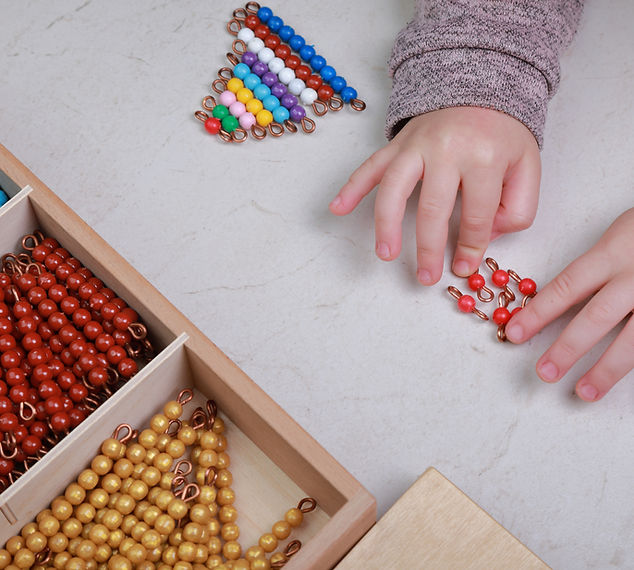
The Montessori approach to mathematics is uniquely hands-on. Using concrete materials such as number rods, golden beads, spindle boxes, and geometric solids, children develop one-to-one correspondence, counting, quantity recognition, and operations — long before encountering abstract equations. 蒙特梭利的数学教学方法独具特色地注重动手操作。通过数字棒、金珠、纺锤棒和几何立体等具体教具,孩子们在接触抽象方程式之前就已掌握一一对应、计数、数量认知和运算。
Children explore spatial awareness through geometric building materials, learn sorting and classification, and are introduced to fractions and place value through sensory-rich experiences. Mathematical concepts and vocabulary are reinforced in both English and Mandarin. 孩子们通过几何建构材料探索空间感知,学习分类和归类,并通过丰富的感官体验接触分数和位值概念。数学概念和词汇以中英双语进行强化。
Discovering the world through geography, science, art, and music. 通过地理、科学、艺术和音乐探索世界。
Cultural Studies is where children explore geography using maps and photographs of the world's different regions. They gain their first sense of history by examining their own timeline from birth to present. Dramatic play allows them to embody different roles and cultures. 文化学习让孩子通过地图和世界各地的照片探索地理。他们通过回顾自己从出生到现在的成长时间线获得最初的历史概念。角色扮演让他们体验不同的角色和文化。
Children explore elements of Botany and Zoology by studying the biological aspects of the environment through hands-on activities — planting seeds, observing insects, and caring for classroom plants. Music education through our partnership with creative arts programs adds another dimension to cultural exploration. 孩子们通过动手活动探索植物学和动物学——种植种子、观察昆虫和照料教室植物。通过我们与创意艺术项目的合作开展的音乐教育,为文化探索增添了另一个维度。
Songs, rhythms, and movement activities in both languages develop listening skills, coordination, and self-expression. 双语歌曲、节奏和律动活动培养听力技能、协调能力和自我表达。
Painting, sculpting, collage, and mixed media projects encourage creative expression and fine motor development. 绘画、雕塑、拼贴和综合材料项目鼓励创意表达和精细运动发展。
Hands-on science experiments, nature walks, gardening, and observation journals foster scientific curiosity. 动手科学实验、自然漫步、园艺和观察日志培养科学好奇心。
Traditional festivals, calligraphy, folk tales, and cultural celebrations bring Chinese heritage to life. 传统节日、书法、民间故事和文化庆典让中华传统文化鲜活呈现。
Outdoor play, yoga, and structured physical activities build gross motor skills, balance, and healthy habits. 户外游戏、瑜伽和结构化体育活动培养大肌肉运动技能、平衡能力和健康习惯。
Peace education, conflict resolution, and mindfulness practices help children build empathy and self-regulation. 和平教育、冲突解决和正念练习帮助孩子建立同理心和自我调节能力。